
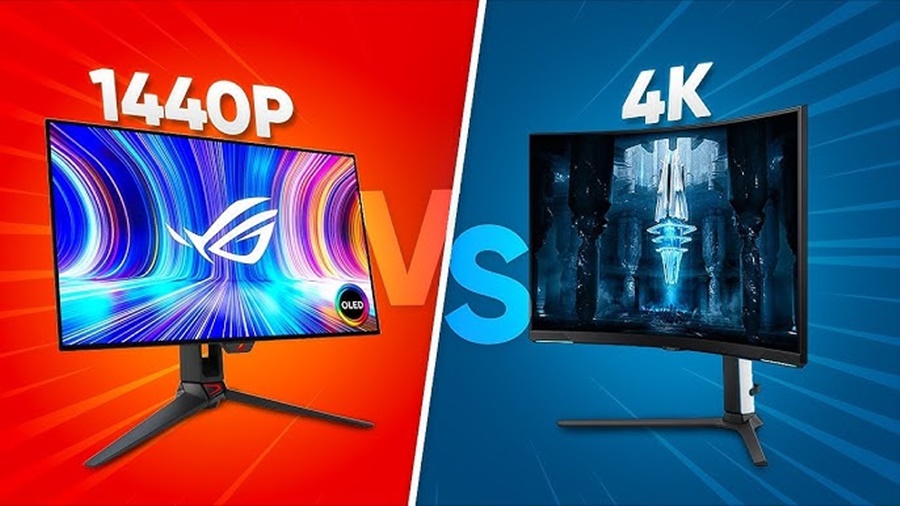
Choosing the right gaming monitor resolution can feel overwhelming especially when 4K and 1440p (QHD) are the two most popular options on the market. Both promise sharp visuals and immersive gameplay, but they cater to very different gaming styles, hardware setups, and budgets.
So which one actually wins?
Let’s break it down step by step.
Understanding the Basics
Before diving into performance and practicality, it helps to understand what these resolutions really mean.
What Is 1440p (QHD)?
- Resolution: 2560 × 1440
- Pixel count: ~3.7 million pixels
- Commonly available in 144Hz–240Hz refresh rates
- Sweet spot for performance and visual clarity
What Is 4K (UHD)?
- Resolution: 3840 × 2160
- Pixel count: ~8.3 million pixels (over twice that of 1440p)
- Typically paired with 60Hz–144Hz refresh rates
- Focused on maximum detail and realism
Visual Quality and Sharpness
4K: Maximum Detail
4K delivers incredibly sharp visuals, especially noticeable in:
- Open-world games
- Story-driven or cinematic titles
- Large monitors (32 inches and above)
Textures, fine details, and distant objects look noticeably crisper. If immersion and visual fidelity are your top priorities, 4K is hard to beat.
1440p: Sharp Enough for Most Gamers
At normal viewing distances, 1440p still looks excellent especially on 27-inch monitors. While it’s not as razor-sharp as 4K, the difference is less dramatic during fast-paced gameplay.
Verdict:
- Visual purists → 4K
- Competitive or all-around gamers → 1440p
Gaming Performance and Frame Rates
This is where the biggest difference shows up.
1440p: High FPS Champion
Because it renders fewer pixels, 1440p:
- Achieves higher frame rates more easily
- Pairs well with high-refresh-rate monitors
- Requires less GPU power
Perfect for:
- Competitive shooters (CS2, Valorant, Call of Duty)
- Esports titles
- Smooth, responsive gameplay
4K: GPU-Intensive
4K demands serious hardware:
- High-end GPUs (RTX 4080/4090, RX 7900 XTX)
- Often requires DLSS or FSR to maintain high FPS
- More difficult to reach 144Hz consistently
Verdict:
- Smoothness & responsiveness → 1440p
- Raw visual power (with strong hardware) → 4K
Refresh Rate and Competitive Advantage
Refresh rate matters just as much as resolution especially in gaming.
- 1440p monitors commonly offer 144Hz, 165Hz, 240Hz, and even higher
- 4K monitors are improving, but high-refresh models are expensive and harder to run
For competitive gamers, higher refresh rates mean:
- Faster reaction times
- Reduced motion blur
- Better tracking in fast-paced games
Winner: 1440p
Hardware Requirements
1440p Hardware Sweet Spot
- Mid-to-high-range GPUs perform excellently
- Less CPU and GPU strain
- More future-proof for upgrades
4K Hardware Commitment
- Requires top-tier GPU
- Demands more VRAM
- Faster hardware becomes outdated sooner at 4K
If you don’t plan on upgrading frequently, 1440p is a safer long-term choice.
Monitor Size and Desk Setup
Resolution works best when matched with the right screen size.
- 1440p: Ideal at 24–27 inches
- 4K: Best at 32 inches or larger
Using 4K on smaller monitors can feel like diminishing returns unless you sit very close.
Price and Value
1440p: Best Bang for the Buck
- Cheaper monitors
- Less expensive GPUs
- Excellent balance of performance and quality
4K: Premium Experience
- Higher monitor cost
- Higher GPU cost
- Higher power consumption
For most gamers, the performance-per-dollar ratio heavily favors 1440p.
Use Cases Beyond Gaming
If you do more than just game, resolution choice can change.
Choose 4K If You:
- Edit photos or videos
- Create content
- Watch high-resolution movies
- Want maximum workspace clarity
Choose 1440p If You:
- Primarily game
- Stream or multitask casually
- Want smooth performance without constant tweaking
Conclusion
When it comes to 4K vs 1440p gaming monitors, there is no universal winner only the resolution that best fits your gaming style, hardware, and budget.
1440p stands out as the best all-around choice for most gamers. It delivers sharp visuals, high frame rates, and smooth performance without demanding top-tier hardware. Its compatibility with high refresh rates makes it ideal for competitive gaming and long-term value.
4K, on the other hand, is the clear winner for visual immersion. If you have a powerful GPU and prioritize stunning detail, cinematic experiences, and larger screen sizes, 4K offers unmatched clarity and realism though at a higher cost and performance demand.